When the blockbuster film Purple Rain (and its 13x Platinum-selling soundtrack) was released in 1984, it made Prince a star. When he released Sign ‘O The Times three years later, it showed the world that Prince was a true artist.
Though not as commercially successful as its predecessor, Sign ‘O The Times is widely regarded—especially by his die-hard fans—as his best album. Admittedly, as a fan with deep loyalty to Purple Rain (both the film and album), I’m torn about that declaration. But the latter record is undeniably a towering achievement, a compendium and panoramic showcase of the musical modes and personalities he would showcase across his career, executed with a virtuosity that, yes, including on Purple Rain, was unparalleled.
Perhaps as fuel for that ongoing debate, but more likely to provide a generation of fans with an opportunity to see Prince live, the artist’s estate—working with Mercury Studios and FilmRise—has remastered the album’s feature-length companion piece Sign ‘O The Times for a one-week theatrical release, in IMAX, starting Aug. 29. Having seen it in this new format, I’m ready to call it the greatest concert film ever made.
Why Prince’s Sign ’O The Times Deserves More Hype Than Purple Rain
I realize that such a claim, in the era of Beyoncé’s Renaissance and Homecoming or Taylor Swift’s The Eras Tour, might seem heretical. And those who’d champion Talking Heads’ Stop Making Sense, Monterey Pop, The Rolling Stones’ Gimme Shelter or The Band’s The Last Waltz could undoubtedly make strong arguments. But much more than simply documenting a performance, Sign ‘O The Times offers one of the purest distillations of an artist’s identity that audiences may ever see.
Directed by Prince himself, the film was originally meant to be photographed in the Netherlands and Belgium in June 1987, several months after the release of the album. A notorious perfectionist, Prince was unsatisfied with either the footage or the sound recordings of those performances, so he returned to his iconic Minneapolis enclave, Paisley Park, to re-shoot the live show, and also to stage the story that provides connective tissue between musical numbers.
The New IMAX Cut Makes This Prince Concert Film Look Unreal
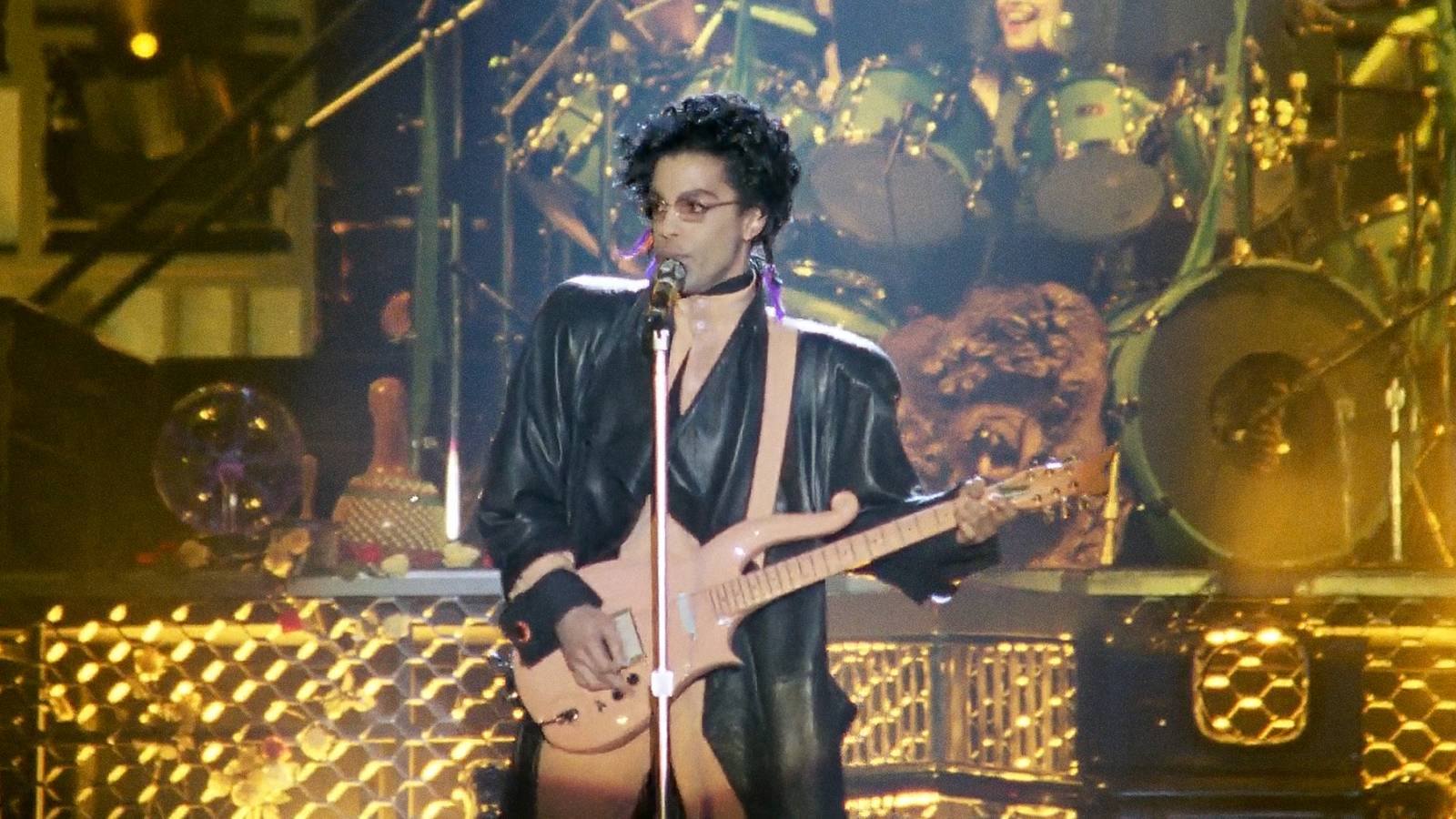
Newly restored, Sign ‘O The Times often looks astonishingly beautiful, but crucially, it still looks like celluloid. Distant early shots of the stage create a mesmerizing glow around Prince in an otherwise pitch-black frame; as the camera advances on him and the band, viewers can luxuriate in the architecture of the elaborate two-tiered setup and watch elaborate call-and-response sequences between him as leader and his many band members. (That said, the “You’ve Got The Look” segment is screened at a significantly lower resolution, the result of virtually nonexistent preservation of music video masters).
Meanwhile, you’re immediately reminded of the proto-MTV musical numbers of Purple Rain, but the editing here by Steve Purcell evidences a faster, more aggressive speed—as if Prince knew he’d already helped create the visual language of music videos and decided now to push it even further.
The set list in the film doesn’t entirely follow the track list of the album, skipping “The Ballad of Dorothy Parker,” “Starfish and Coffee,” “Strange Relationship” and “Adore.” It also includes a cover of Charlie Parker’s “Now’s The Time,” a spotlight for the band that transitions into a drum solo by Sheila E. But it captures Prince’s many moods—rock star and jack-of-all-trades instrumentalist, lothario and romantic, spiritual dreamer and chronicler of unvarnished emotional realities. Live, it would be the kind of album-centric concert that gave fans everything they could ask for; on screen, it feels perfectly paced and modulated, to give viewers crowd-pleasers and deep cuts, fast and slow tracks to take them on a ride. And in many cases, the versions of these songs are even better on the album that inspired them—a considerable achievement even for a consummate musician like Prince.
Sheila E. And Prince Trade Spotlight In One Of Music’s Coolest Live Performances
The latter detail is certainly amplified by the audio mix of the film’s new presentation: every instrument is wonderfully clear, from the elastic bassline on Prince’s electric guitar to Eric Leeds and Atlanta Bliss’ piercing horns to Levi Seacer Jr.’s bass to former Revolution member Doctor Fink’s keyboards. But Sheila E. in particular is the group’s not-so-secret weapon on the drums, creating a cavernous, irresistible sound whose charisma in front of the camera is almost equal to Prince’s. During one number late in the concert, she leaps into a chorus line of backup singers and her commitment to the choreography is so mesmerizing that you almost forget she’s just there to support him.
At the same time, her dedication (and the entire band’s) reflects Prince’s demand for unflagging musicianship. It starts with himself, not least of which because he played so many of the instruments whose sound they’re recreating on stage—in some cases, an acoustic instrument to replicate, say, a drum machine or synthesizer. (If further evidence is needed of the standards he sets for himself above his musicians, he allows his female backup dancer Cat Glover to wear flats while he reverses the Ginger Rogers refrain by doing all that she is, except backwards and still in his signature heels.) But they all seem to work in perfect synchronicity, and yields the spotlight to them several times throughout the concert, even if it’s his charisma and stage presence that draws the viewer’s attention.
That further extends to the “plot,” so to speak, that Prince uses as the glue for his set list. Focusing on a tenuous love triangle between lovelorn lead dancer Glover, a callous band member and Prince himself, no one would confuse this for a real story, even by the forgiving standards of some of the artist’s cinematic output. But in addition to giving Prince a leading lady to woo and often dance with, the romantic clashes between the three create openings for song transitions and provide comic relief. It’s also more than a little bit corny, but it’s exactly that tone that aligns with the totality of Prince’s identity—playful and also serious, measured but shaggy. Like his best work, the concert feels very precisely choreographed but never too tightly controlled, always feeling like it’s alive.
It’s that last quality that ultimately sets apart this concert film from those of more contemporary artists, who perhaps appropriately make sure they’re so well-rehearsed that every movement or note becomes second nature. Did Prince plan beforehand which songs he’d step away from the microphone and dance to? Of course, but it doesn’t feel that way.
The songs alone more than highlight his versatility, his capacity to weave disparate genres together and the bottomless depths of his musical talent. But within Sign ‘O The Times, Prince seemed to offer fans (and God help them, those unconvinced of his greatness) a complete portrait of his soul as an artist. Even in his absence, that’s a gift that keeps on giving today.





0 Comments