10 Sci-Fi Miniseries That Rival Long-Running Shows in Impact and Creativity
Sci-fi miniseries have long been overshadowed by bigger names in the genre. For decades, the small screen’s sci-fi conversation has been dominated by legacy-heavy franchises like Star Trek or sprawling multi-season hits like The Expanse and Farscape. Even shows cut short like Firefly or The Peripheral attract more attention than shorter completed stories.
This format bias has led many sci-fi fans to miss out on some of the most inventive, self-contained stories television has produced. Short-form sci-fi storytelling has thrived across decades, producing shows that wrapped up in a single season with precision and focus. Many of these series rival – or even surpass – the best long-running sci-fi shows, making them essential viewing for genre enthusiasts.
There are plenty of sci-fi miniseries that not only hold their own against the giants of the genre but often surpass them. These shows tell powerful, complete stories in just a few episodes, yet their impact resonates far beyond many sprawling sagas.
Taken (2002)
A Sweeping Alien Saga Condensed Into One Unforgettable Miniseries
Taken, produced by Steven Spielberg, is an ambitious intergenerational alien abduction story that spans fifty years of human history. Following multiple families entangled in extraterrestrial secrets, it manages to explore themes of government conspiracy, human resilience, and alien mystery in just ten episodes. The scale is as wide as many long-running series, but the narrative is far more focused.
One of its strengths lies in how it blends deeply personal human drama with cosmic stakes. From Russell Keys (Steve Burton), a traumatized World War II pilot haunted by abductions, to Allie Keys (Dakota Fanning), a child whose destiny may reshape humanity, the show grounds its alien mythology in relatable character arcs. The miniseries format ensures that every storyline is wrapped up, avoiding the loose threads that plague longer series.
Fans of shows like The X-Files or Roswell will find plenty to love here, but Taken’s ability to deliver an epic alien mythology without overstaying its welcome makes it stand apart as one of sci-fi television’s most memorable short runs.
The Triangle (2005)
The Bermuda Triangle Mystery Reimagined As High-Concept Sci-Fi
The Bermuda Triangle has fascinated storytellers for decades, and The Triangle turns that fascination into a taut six-part sci-fi thriller. Executive produced by Bryan Singer and Dean Devlin, the series throws together a team of specialists – including skeptic reporter Howard Thomas (Eric Stoltz) – to solve the Triangle’s mysteries, and what unfolds is both eerie and surprisingly inventive.
What makes this miniseries stand out is its willingness to push beyond clichés. Instead of sticking to disappearing ships and planes, it dives into alternate realities, time loops, and government cover-ups, weaving a story as imaginative as it is suspenseful. Its concise structure prevents it from collapsing under the weight of its big ideas, something that often happens with multi-season sci-fi shows.
Those who enjoyed the likes of Fringe or Lost will feel at home with the show’s blend of mystery, paranoia, and shifting realities. By the time the story concludes, The Triangle has transformed one of history’s most enduring mysteries into a truly satisfying sci-fi tale.
The Lost Room (2006)
A Strange Motel Room Unlocks One Of Sci-Fi TV’s Most Creative Mythologies
Few sci-fi miniseries have achieved the cult reputation of The Lost Room. Centering on detective Joe Miller (Peter Krause), the story begins when he discovers a key that opens any door into a mysterious motel room. Inside are bizarre objects, each with inexplicable powers, forming the backbone of one of television’s most original mythologies.
What sets The Lost Room apart is its ingenuity. Every new object introduces both wonder and danger, from a comb that stops time to a bus ticket that teleports people to a desert road. However, beneath the high-concept sci-fi is a grounded emotional core: Miller’s desperate search for his missing daughter Anna (Elle Fanning). The miniseries manages to balance imagination and humanity without needing multiple seasons.
For fans of Doctor Who or the cult Netflix show Archive 81, The Lost Room offers a rare blend of high-stakes mystery and personal drama. It remains a standout example of how the miniseries format can deliver a story as rich as any franchise epic.
11.22.63 (2016)
A Time Travel Thriller That Turns History Into A Ticking Clock
Based on Stephen King’s novel, 11.22.63 sends teacher Jake Epping (James Franco) back in time to stop the assassination of John F. Kennedy. Produced by J.J. Abrams, this Hulu miniseries cleverly merges historical drama with time-travel science fiction, creating a suspenseful eight-part story where every moment counts.
Unlike many long-running time travel shows, 11.22.63 benefits from its single-season structure. The tension never lets up, as Jake grapples with butterfly-effect consequences, sinister forces resisting history’s change, and the moral weight of altering the past. The show also builds emotional resonance through Jake’s relationship with librarian Sadie Dunhill (Sarah Gadon), adding humanity to the historical thriller.
11.22.63 has a lot of thematic similarities with Quantum Leap when it comes to its mix of emotional stakes and sci-fi paradoxes. What makes 11.22.63 shine, though, is how it keeps its time-travel rules tight, delivering a complete story that balances history, suspense, and heart.
V (1983)
A Classic Alien Invasion Tale That Still Packs A Political Punch
Before it became a franchise, the hugely influential sci-fi showV began as a two-part miniseries, introducing the chilling story of alien “Visitors” arriving on Earth. Led by the seemingly benevolent Diana (Jane Badler), the aliens promise peace but hide a darker agenda. The original miniseries uses its short runtime to craft a tight, allegorical narrative about authoritarianism, resistance, and deception.
Its impact lies in its blend of pulpy sci-fi spectacle with biting political commentary. Inspired by anti-fascist allegory, creator Kenneth Johnson framed the Visitors as a metaphor for totalitarian regimes, giving the story more thematic weight than many alien invasion shows that came later. Even decades on, its social critique feels timely and sharp.
Easily as gripping as many modern shows with similar themes, such as Battlestar Galactica or Colony, V remains essential viewing. While it eventually expanded into sequels and a reboot, the original 1983 miniseries still stands as the purest version of the story – concise, haunting, and unforgettable.
Bodies (2023)
A Murder Mystery Across Centuries Becomes One Of Netflix’s Boldest Sci-Fi Experiments
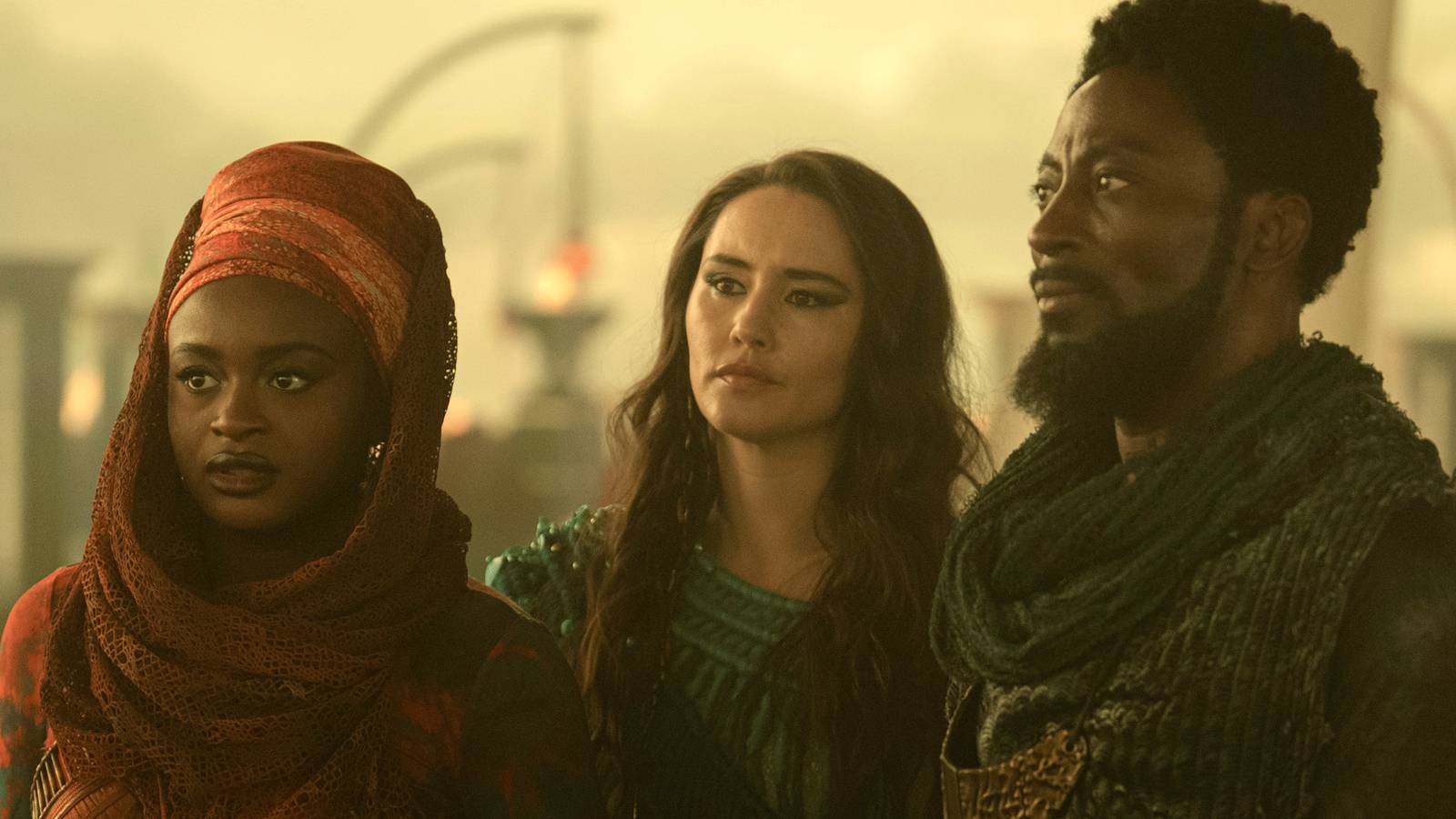
Netflix’s Bodies delivers one of the most ambitious sci-fi miniseries of recent years. When detectives across four different timelines – including Alfred Hillinghead (Kyle Soller) in 1890 and Shahara Hasan (Amaka Okafor) in 2023 – discover the same body, the story unfolds as a genre-bending mystery that connects across centuries.
The brilliance of Bodies lies in how it juggles timelines without collapsing under complexity. Each era has its own style, yet the threads tie together into a cohesive narrative about power, control, and the cyclical nature of history. In just eight episodes, it manages to weave a sprawling epic that many multi-season shows would struggle to pull off.
Just as good a mystery thriller as it is sci-fi, fans of shows like True Detective will appreciate the dense storytelling and detective noir elements. By its conclusion, Bodies proves that a miniseries can be as sweeping as a time-travel epic while still delivering the satisfaction of a complete, perfectly tied-off narrative.
Ascension (2014)
A Generation Ship Mystery That Proves One Season Can Pack A Twist-Filled Punch
Ascension begins with a tantalizing premise: in the 1960s, the U.S. secretly launched a generation ship carrying hundreds of people into space. Decades later, the ship is still traveling, but its passengers begin to question their mission after a murder shatters their community. What follows is a miniseries packed with revelations that reshape everything viewers thought they knew.
What makes Ascension so effective is its willingness to subvert expectations. The story isn’t just about life on a spaceship – it becomes something much stranger, offering commentary on surveillance, societal control, and human ambition. Each episode layers new twists, showing how a limited run can make sci-fi storytelling feel sharp and surprising rather than stretched thin.
The themes of identity and existentialism give Ascension as much in common with movies like The Truman Show as it has with hit sci-fi like The Expanse. When it comes to sci-fi TV shows, the contained structure gives Ascension its edge. It’s a miniseries that thrives because it only needed six episodes to tell its shocking, tightly plotted tale.
Maniac (2018)
A Psychedelic Dive Into The Mind That Bends Sci-Fi Into Surrealism
Cary Joji Fukunaga’s Maniac is unlike any other sci-fi miniseries. Starring Jonah Hill as Owen Milgrim and Emma Stone as Annie Landsberg, the story follows two strangers who enter a pharmaceutical trial that promises to fix their psychological struggles. What follows is a kaleidoscopic journey through dreamscapes, simulated realities, and fragmented identities.
Instead of focusing on grand sci-fi spectacle, Maniac explores the inner landscapes of its characters. Each episode shifts genres while retaining a sci-fi backbone rooted in artificial intelligence and neurological experimentation. The limited format allows it to embrace eccentricity without losing focus.
Fans of Eternal Sunshine of the Spotless Mind or Black Mirror will find much to admire in its mix of emotional vulnerability and futuristic weirdness. Maniac outshines many longer shows simply by refusing to compromise its vision, delivering a story that’s as strange as it is deeply moving.
Station Eleven (2021)
A Post-Apocalyptic Drama That Finds Hope In Humanity’s Ruins
Station Eleven, based on Emily St. John Mandel’s novel, is a miniseries that proves sci-fi doesn’t have to be cold or clinical. Following Kirsten Raymonde (Mackenzie Davis) and a troupe of traveling performers in a world devastated by a flu pandemic, it weaves a story about survival, art, and the connections that endure even in catastrophe.
What makes Station Eleven remarkable is its focus on hope. Instead of reveling in collapse, it shows humanity rebuilding through storytelling and community. Its nonlinear narrative draws viewers into multiple timelines, creating a layered emotional experience that most long-running post-apocalyptic shows rarely achieve.
Station Eleven resonates just as deeply as many other epic apocalyptic sagas like The Leftovers or The Last of Us. In just ten episodes, Station Eleven crafts an intimate, moving vision of the future that lingers long after the credits roll – something even the most epic multi-season series rarely accomplish.
Devs (2020)
A Haunting Meditation On Technology, Fate, And Free Will
Created by Alex Garland, Devs is a visually striking, philosophically heavy miniseries centered on Lily Chan (Sonoya Mizuno), who investigates the secretive tech company Amaya after her boyfriend’s disappearance. At its core is a quantum computing project that questions the very nature of reality, free will, and determinism.
The miniseries format allows Devs to stay laser-focused on its themes. Every episode builds tension through striking visuals, haunting sound design, and meditative pacing. Unlike many long-running shows that dilute their ideas, Devs commits to its vision fully, offering a blend of mystery, thriller, and philosophical inquiry that sticks with viewers.
The mix of cerebral science fiction and human drama in Devs is captivating. It truly stands alone among sci-fi miniseries, weaving a unique story that’s all its own. Devs is proof that sometimes eight episodes are all that’s needed to create one of the most impactful, unforgettable works of sci-fi television.






0 Comments